The reason
The honest beginning is a person, not a business plan. The woman I wanted to build a life with was in Japan, and I was finishing university in Washington, D.C. This was before remote work became ordinary. Nobody was going to employ me in America and let me live on the other side of the world, so the income would have to be built.
I began looking at the unglamorous part of the economy: cleaning, lawn care, junk removal, and the ordinary services people need in every town. The work happens locally, but much of the company does not. Enquiries, booking, scheduling, follow-up, quality control, and hiring can all be managed from a desk anywhere.
In my final semester, I started a cleaning company with seven hundred dollars and no industry experience. What I did have was a useful constraint. I was not going to be there. Not sometimes. Ever.
The distance
Most service business problems are solved the same way. The owner appears, absorbs the confusion, and saves the day. That can feel responsible, even admirable, while teaching the business never to cope without them. I would not have that option from Japan. A missed appointment, an unhappy customer, or a cleaner who failed to arrive needed a response that did not depend on my physical presence.
The first version was plain: a spreadsheet, a virtual phone number, a subcontracted crew, and a growing collection of written instructions. Most people I told about the idea politely changed the subject.
So Think Maids was built as infrastructure rather than a series of rescues. Phones were answered by people hired for warmth and trained with documentation. Scheduling, quality control, hiring, and payroll were each written down, tested, and handed over.
A few months after graduation I moved to Japan. The company remained in Washington, D.C., while I worked from a desk overlooking a small Tokyo park. Customers did not know where I was. More importantly, they did not need to.
The next several years were the model meeting reality. We learned how to hire without seeing the room, how to protect the customer experience when the product was also the team, and how to place managers between the owner and the daily operation without losing the human quality of the service.
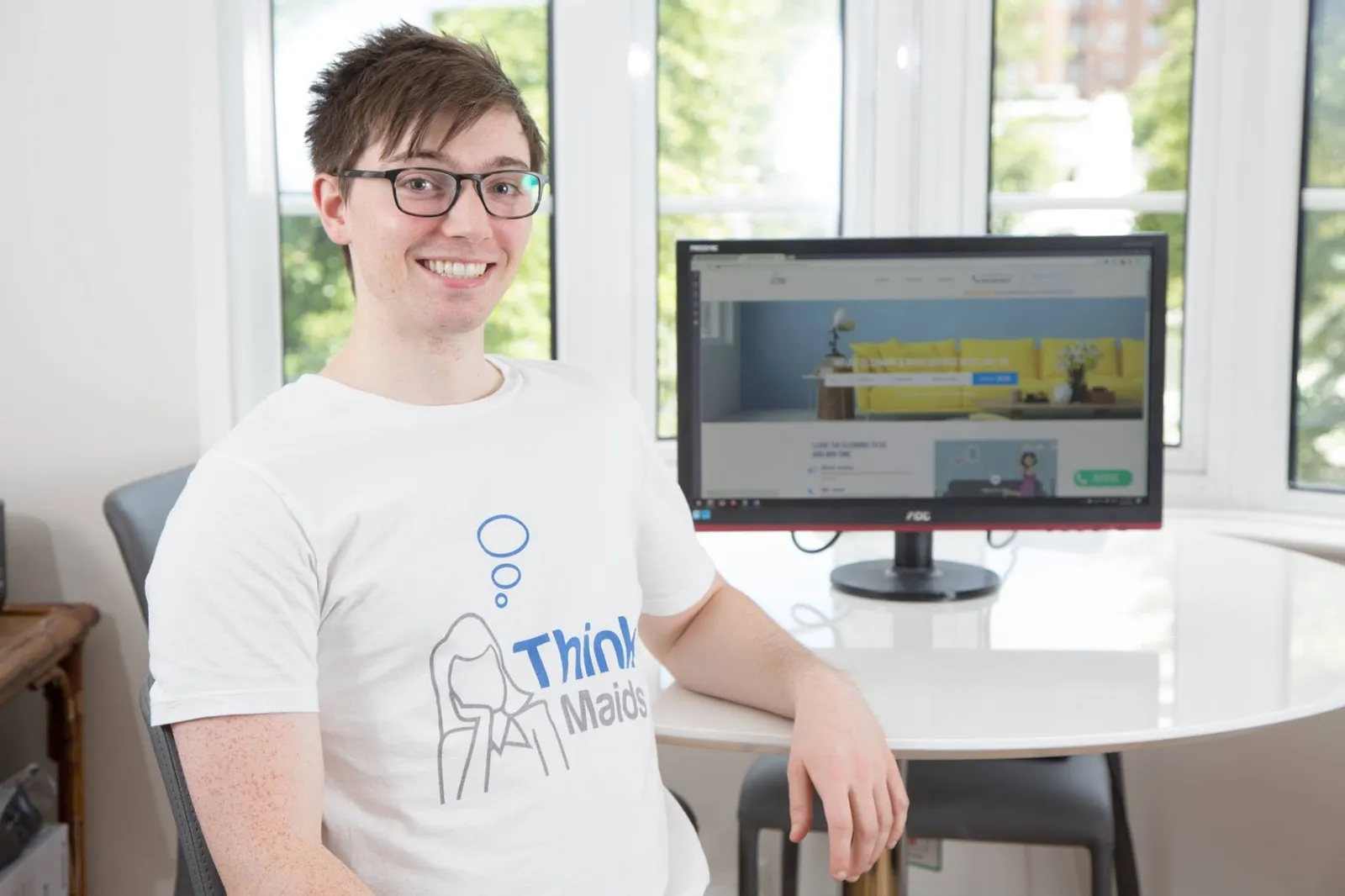
Think Maids grew into a national cleaning company. I never met a customer. After I stepped away from daily operations it continued to run, and in 2024 an industry buyer acquired it. The sale answered a harder question than whether the company could make money. It showed that the systems, the team, and the customer relationships had value without the founder attached.
What looked like an eccentric constraint turned out to be an operating system. Owners began asking how it worked. Then more owners. The answer got a name, the remote local business, and began to spread.
The model spreads
I began building Think Maids publicly in 2016, sharing the mechanics as they developed: the org chart, the hiring process, the scripts, and the slow work of handing off responsibilities owners believed only they could carry. It became an early case study for the remote local business model. First a few people built companies this way, then dozens, then thousands of operators around the world. The work remained local. The company around it became increasingly remote.
They ran into the same wall I had. There was always a category of work that apparently only the owner could do. On inspection, much of it was undocumented, poorly bounded, or never genuinely delegated.
In 2017, that need became Inova Local, the first virtual staffing agency dedicated to home services. Owners understood the remote model but wanted help freeing themselves from the work that still returned to them. Inova began with the team and training systems developed inside Think Maids, then served companies across North America, including national franchises and Inc. 5000 operators. In 2025 it was acquired by private equity.
The school
In 2018, the work became the Local Business MBA. It began with a simpler question: what would business education look like if the final project were a company you owned?
The programme teaches the sequence I wish I had understood at the beginning: choose practical demand, launch simply, build reliable acquisition, make delivery repeatable, hire carefully, and gradually remove the owner from routine decisions.
It is not a promise of effortless income. Businesses ask something of their owners, especially early on. The aim is to make that effort build an asset and a more capable operator, rather than a job that becomes harder to leave each year. A traditional business degree runs north of two hundred thousand dollars; the graduation project here is a business you own. More than 250 students in sixteen-plus countries have joined the programme.
The practice
Alongside the businesses is a Zen practice. It taught me to distrust unnecessary motion, to notice how tightly I hold plans, and to simplify before adding. Those lessons later appeared in the businesses as fewer priorities, clearer roles, and a willingness to let other people solve problems differently from me.
Stillness is not a prize waiting at the end of the work. It changes how the work is done. The yearly one-word intention (this year: simplify) is part of the same practice.
The life
The businesses were never the final point. They were vehicles for a life, and for work that could be useful to other people. The plan worked. We married and built a home in Japan. There is a small family now, a dog with strong opinions, hills and sea nearby, and mornings that still belong to writing, walking, and sitting before the day fills up.
The work continues, but it takes up a more deliberate amount of space. That is the promise I care about: a business that gives you choices about how much of yourself to give, protects income from being tied to one employer, and creates room for deeper commitments.
Freedom is valuable, but it is incomplete on its own. The question that follows is what the freedom is for. Family, study, service, health, creative work, another company, or simply the ability to meet life with more attention are all good answers. Business as Practice is where I set the work down, most weeks. If any of this sounds like the life you are trying to build, the door is open.